On March 9, the Central Khurul of Kalmykia “The Golden Abode of Buddha Shakyamuni” Held the Celebration of the “Day of the Manifestation of Buddha Shakyamuni’s Miraculous Powers”
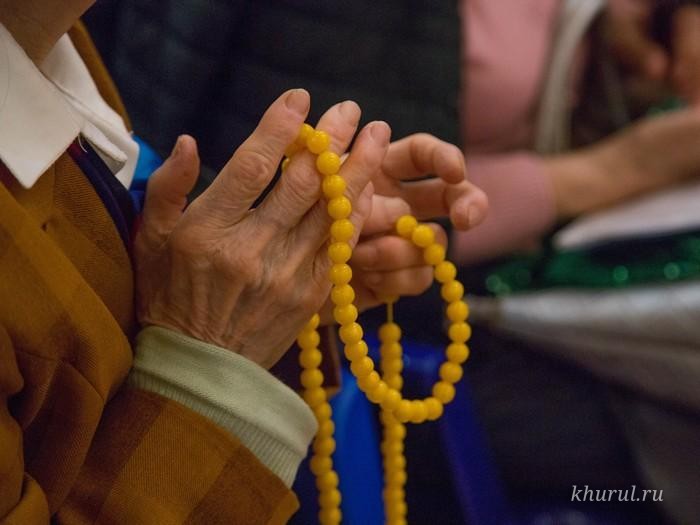
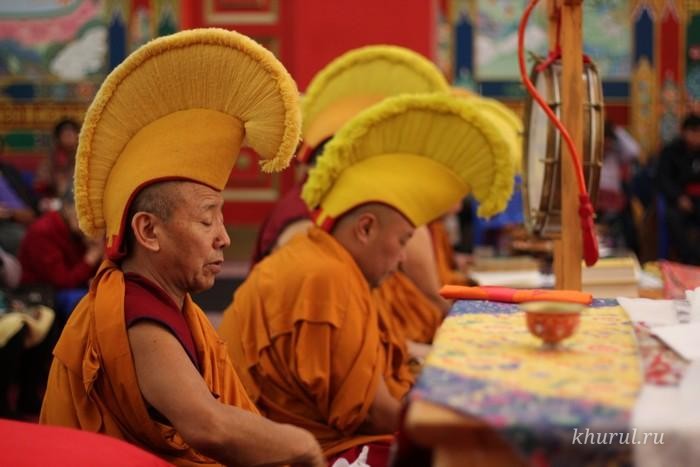
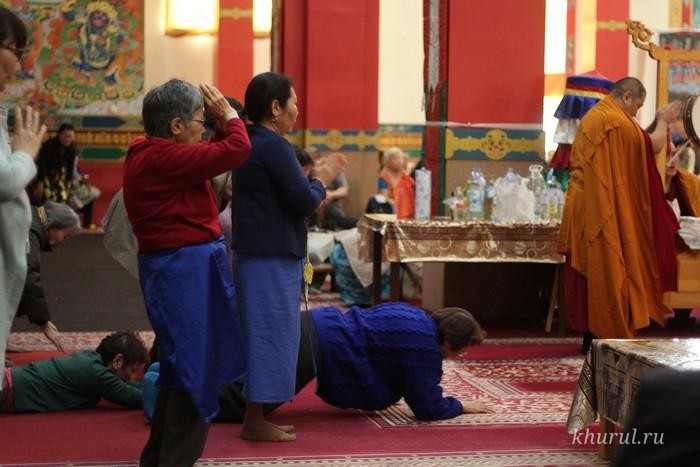
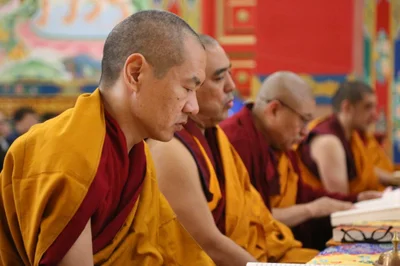
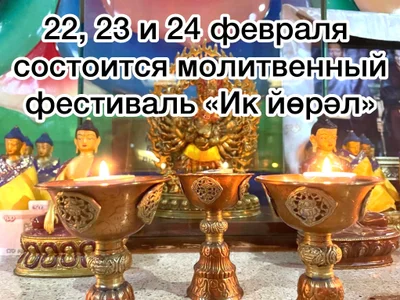
The Central Khurul of Kalmykia held the celebration — Burkhn Bagsh khüvlhän üzülsn ödr (the Day of the Manifestation of Buddha Shakyamuni’s Miraculous Powers). Over three days, beginning on March 7, the great prayer assembly Ik Yöräl (Monlam Chenmo) was held at the Central Khurul.
More than 2,500 years ago on this day, Buddha Shakyamuni concluded with a brilliant victory and a display of miracles his debate with the six false teachers, which lasted fifteen days (from the first lunar day of the first month — Tsagan Sar). In the biography of the Buddha compiled by Taranatha it is said that for the debate “an innumerable multitude of people gathered, wishing to see the great miracles, as well as countless deities, nagas, asuras; there were garudas, pishachas, kushmandakas, kinnaras, bhutas.” Over fifteen days the Buddha manifested his powers, working miracles as proof of the truth of the faith he preached. After this, a countless number of the false teachers’ followers went over to the Buddha’s side and accepted his Teaching.
In honor of the momentous victory of Buddha Shakyamuni, the Ik Yöräl (Monlam Chenmo) was established, which began to be celebrated from 1409 (the year of the Earth Ox) in Lhasa. This festival was established by the great Zunkva Gegyan (Lama Je Tsongkhapa).
The Buddha and his disciples were invited to the court of the king in Rajagriha. The younger brother of King Bimbisara followed the false teaching of the tirthikas, who were his advisers. The Buddha and his disciples were seated at the table. Although the king’s six advisers were already seated at that table in places of honor, the moment the Buddha and his disciples came to sit beside them, these false teachers suddenly found themselves at the far end of the table. Three times they moved back to their places of honor, and three times they were again carried to the very end. When jugs of water were offered to them, the water refused to flow from them, but poured of itself onto the hands of the Buddha and his disciples. The same thing happened with the food that was offered, and when the ruler asked the Buddha for instruction in the Teaching, the Victorious One suggested that he first ask his learned advisers about it. But the false teachers could not open their mouths and only signaled to the ruler that he should ask the Buddha.
After this the Buddha gave instructions in the Dharma, and all those present attained various spiritual fruits — some entered the monastic community and were inwardly purified, others gave rise to thoughts of spiritual awakening. In doing so, each understood whose teaching was true and ceased to believe the six false teachers, to venerate them and to make offerings to them.
Shamed and enraged, the false teachers withdrew and began to ponder what had happened. Perhaps later they might have conquered their anger and entered the path of the Dharma, for they too had received the gift of the Teaching from the Buddha’s lips. But then Mara, Son of the Heavenly Beings, himself intervened — the lord of the Heavens of those who rule the beings of the kama-loka by gratifying their desires and creating illusions. Mara took on the appearance of the eldest of the false teachers and displayed his magical art — he spewed fire and water, flashed lightning, and persuaded the rest to challenge the Buddha to a magical contest, to shame him and to win back the faith of the people and the respect of the rulers.
The Buddha accepted the challenge, but a day before the contest he departed with his disciples to another city. The tirthikas decided that he had been frightened of the contest and grew greatly proud. They followed the Buddha and demanded that the contest be held. The Buddha agreed, but again moved on to another city. This was repeated several times, and in the end kings with their retinues and a great number of people followed the Buddha, awaiting the magical contest. Finally, in the city of Shravasti on the first day of the first lunar month, before a great gathering of people, the contest took place, and on the 15th lunar day the Buddha completed his display of miracles, decisively defeating the false teachers and thereby strengthening in his disciples faith in the “Three Jewels”.
What happened in these days in the time of the Buddha is told in the Sutra of Wisdom and Folly (Dzanlundo). The sutra tells how six false teachers — advisers to the younger brother of King Bimbisara, who had led the king himself and the people of his land astray from the path of the Teaching — attempted to shame the Buddha by challenging him. It was precisely in these days that Buddha Shakyamuni, during his debate with the false teachers, displayed his miraculous powers.
On the first day the Buddha performed the first miracle. He thrust a wooden toothpick into the ground, which at once began to grow and swiftly grew into a huge tree whose flowers were the size of a cartwheel and whose fruits were the size of a large jug. The trunk, branches, foliage and fruits of this tree were made of all manner of jewels, which outshone the sun with their light, and when the wind blew, the branches gave forth the melodious sound of the Dharma. Those who tasted its fruits found them divine. Merely to smell the sweet fragrance of the tree and its fruits made people joyful and happy. This tree gave rise in the gathered people to thoughts of faith. Then the Buddha bestowed the Teaching, and those present attained many spiritual fruits.
On the second day the Buddha performed the second miracle. To his right and left he created two very large mountains made of jewels of five colors. On the mountains grew lush trees with juicy fruits, flowers bloomed, and melodious sounds rang out. On the summit of one mountain grew juicy and delicious fruits, with which all the gathered people were amply satisfied. And the summit of the second mountain was covered with lush, velvety grass, which the inhabitants of the animal world enjoyed. After this the Buddha bestowed the Teaching, and the minds of the gathered were completely purified.
On the third day the Buddha performed the third miracle, rinsing his mouth after the meal and spitting out the water. The water began to spread and turned into a large pond adorned with jewels. The water of the pond possessed eight miraculous qualities, and its surface was covered with a multitude of lotuses of all colors. The radiance emanating from these lotuses lit up the sky and the earth with light. After this the Buddha bestowed the Teaching, and the number of those who took the path of performing deeds that generate good merit increased.
On the fourth day the Buddha performed the fourth miracle. On this day he caused eight great channels to appear at the corners of the jeweled pond, the water from which flowed out, encircled the pond, and poured back in. And in the murmur of the flowing water one could hear a voice that preached about the various aspects of the Teaching. Many were imbued with the Teaching, listening to this voice of the Dharma, and set out on the path of becoming a buddha.
On the fifth day the Buddha performed the fifth miracle. Parting his lips, the Victorious One emitted a ray of golden light and illuminated the sphere of the great thousand worlds. Those living beings whom this ray touched were freed from the three poisons and the five defilements, and attained bodily and mental tranquility like a monk immersed in the third dhyana. After this the Buddha bestowed the Teaching, and many of those present gave rise to thoughts of the highest spiritual awakening.
On the sixth day the Buddha performed the sixth miracle. He made it so that all the gathered people became able to read one another’s thoughts. Thus, all those present learned of one another’s good and unwholesome deeds and thoughts. Rejoicing at such a miracle, the people glorified the miraculous powers of the Buddha and offered prayers for the swiftest possible enlightenment.
On the seventh day the Buddha performed the seventh miracle. By the power of his miraculous abilities he made it so that each of the people present felt himself to be the universal monarch Chakravartin, lord of the world, to whom vassals and princes pay their respects. Feeling himself a Chakravartin, each of the gathered rejoiced greatly, and to them, rejoicing, the Buddha bestowed the Teaching. As a result, all attained deep satisfaction and gained spiritual fruits.
On the eighth day the Buddha performed the eighth miracle. Seated on the lion throne, the Buddha pressed upon it with his hand. At once a loud roar sounded and five rakshasas appeared, who snatched the seats from under the six tirthikas and smashed them to pieces. Vajrapani raised above the heads of the tirthikas a vajra spewing flame, and in fear they threw themselves into the river, where they met their end. Then ninety thousand people from the retinue of the tirthikas turned to the Buddha with a request to accept them as monks. “Come in blessedness,” the Buddha answered them. And at once their heads shaved themselves, and they became monks. The Buddha bestowed upon them the Teaching, after which they were fully purified and became arhats.
After this, from each of the eighty thousand pores of his body the Buddha emitted rays of light, which filled the entire sky. At the tip of each ray the Buddha, by the power of his abilities, created a great lotus, upon which a buddha was seated and bestowed the Teaching. Many of those present, seeing such miracles, were strengthened still more in faith. And when the Victorious One bestowed upon them the Teaching, they attained great spiritual merits.
On the ninth day the Buddha performed the ninth miracle. By the power of his magical abilities the Buddha made his body incredibly large. Shining, it rose into the heavens, reaching the sphere of the world of the god Brahma. And the bright rays issuing from it illuminated the earth and the heavens around. Beholding this and hearing the Teaching from the Buddha’s lips, those present gave rise to the thought of the highest spiritual awakening.
On the eleventh day the Buddha performed the eleventh miracle. Immersing himself in meditative concentration, he made his body invisible. And then, emitting a ray of bright light, in very melodious words he expounded the Teaching in detail. Seeing this, many of those present gave rise within themselves to the thought of the highest spiritual awakening.
On the twelfth day the Buddha performed the twelfth miracle. He emitted golden rays of light, which filled the space of the sphere of the thousand great worlds. All living beings whom these rays of light touched fully subdued the unwholesome thoughts connected with the three poisons and gave rise to thoughts of mercy. When the Buddha bestowed the Teaching upon the gathered, many laid a good foundation for a divine or human, higher, rebirth.
On the thirteenth day the Buddha performed the thirteenth miracle. On that day the Buddha, seated on the lion throne, emitted from his navel two rays of light. At the end of each ray a lotus formed, and upon each lotus abided a nirmanic buddha. Each nirmanic buddha also emitted from his navel two rays, upon which were a lotus and a buddha. This continued until the entire sphere of the thousand great worlds was filled with buddhas. At the sight of such a miracle the gathered were filled with faith in the Teaching.
On the fourteenth day the Buddha performed the fourteenth miracle. On this day the Buddha was invited to a meal by King Uttarayana, who scattered flowers before the Victorious One. The Buddha turned these flowers into one thousand two hundred and fifty chariots with precious stones, which with their light illuminated the sphere of the three thousand great worlds. All beheld this miracle, and the Buddha bestowed the Teaching upon the gathered.
On the fifteenth day the Buddha performed the fifteenth miracle. On this day the Buddha was invited to a meal by King Bimbisara. On the eve the Buddha had said to him: “King! Prepare only the dishes for the food.” At noon the dishes were magically filled with excellent and varied delicacies, tasting of which all those present attained bodily and mental peace. Then the Buddha struck the ground with his hand and made visible to all the gathered the immeasurable sufferings of living beings in the eighteen hells. From what they saw, all the people were so frightened that they gave rise to the thought of compassion. And when the Buddha bestowed the Teaching upon them, the hearts of the people were filled with satisfaction. Because the inhabitants of the hells also beheld the Buddha and heard his Teaching, their term of stay in hell was exhausted, and they gave rise to thoughts of faith and attained a good rebirth.
The miracles manifested by the Buddha and the accompanying bestowals of the Teaching became the cause of many beings setting out on the path of the Dharma. And therefore, out of the greatest desire for the benefit of all living beings, Zunkva Gegyan (Lama Tsongkhapa) six centuries ago established this tradition of the Ik Yöräl (Monlam Chenmo). All practices done in these 15 days with pure thought and motivation will bring immeasurably great fruits.
Photo: Rema Kin