
His Holiness the Dalai Lama (Tenzin Gyatso)
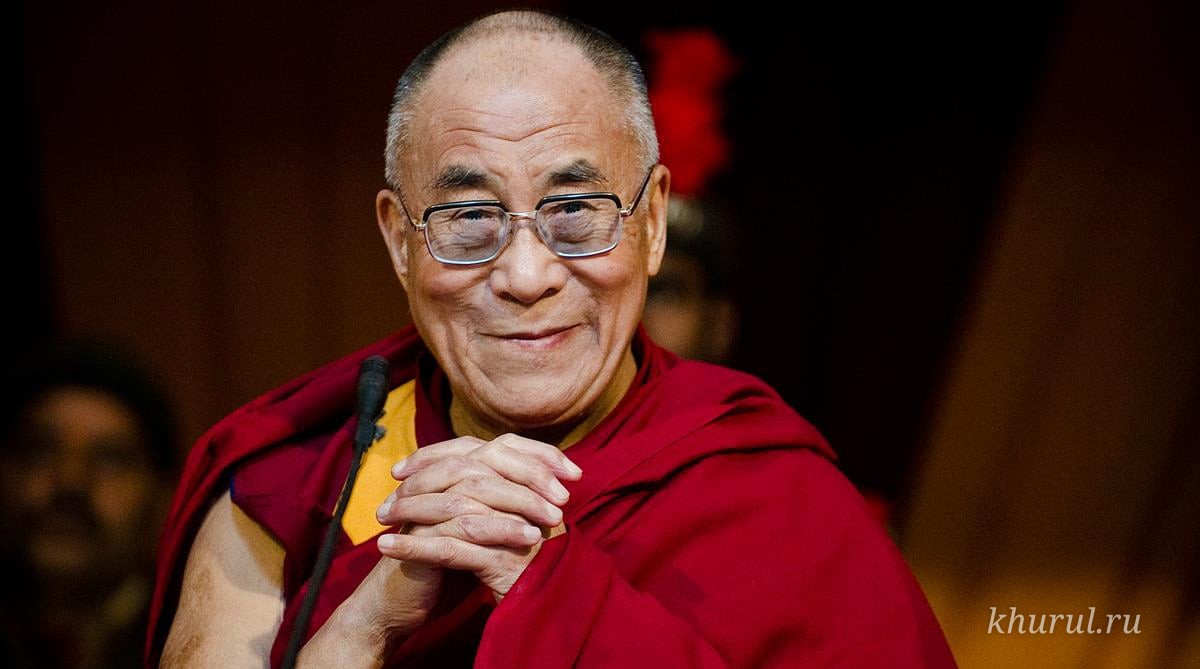
His Holiness the Fourteenth Dalai Lama, Tenzin Gyatso, describes himself as a simple Buddhist monk. The Dalai Lama is the spiritual leader of the Tibetan people. He was born on 6 July 1935 to a peasant family in the small settlement of Taktser in the Amdo province in northeastern Tibet. At the age of two, the child, then named Lhamo Dhondup, was recognized as the reincarnation of the previous Thirteenth Dalai Lama, Thupten Gyatso.
Followers of Tibetan Buddhism revere the Dalai Lamas as manifestations of Avalokiteshvara, or Chenrezig, the Bodhisattva of Compassion and patron of Tibet. A bodhisattva is a being who has dedicated himself to attaining the highest goal of spiritual seeking, awakening, for the sake of the happiness and welfare of all sentient beings, and who has vowed to be reborn again and again in order to help them.
Education in Tibet
His Holiness began his schooling at a monastery at the age of six. The curriculum, deriving from the tradition of the Nalanda monastic university, consisted of five major and five minor subjects. Among the major disciplines were logic, fine arts, Sanskrit grammar and medicine, but the greatest emphasis was placed on Buddhist philosophy, which in turn comprised five categories: Prajnaparamita, the perfection of wisdom; Madhyamaka, the philosophy of the Middle Way; Vinaya, the code of monastic discipline; Abhidharma, metaphysics; and Pramana, logic and epistemology. Among the five minor subjects were poetry, drama, astrology, composition and the study of synonyms.

His Holiness the Dalai Lama during the final examinations for the Geshe Lharampa degree, held in Lhasa, Tibet, from the summer of 1958 to February 1959. (Photo: OHHDL)
In 1959, at the age of 23, His Holiness sat his final examinations at the Jokhang Temple in Lhasa during the Great Prayer Festival (Monlam Chenmo). Passing with honours, he was awarded the Geshe Lharampa degree, the highest academic degree in Buddhist philosophy.
State responsibilities
In 1950, after the start of the Chinese invasion of Tibet, the Tibetans asked His Holiness to assume political power in the country. In 1954 he travelled to Beijing, where he met Mao Zedong and other Chinese leaders, including Deng Xiaoping and Zhou Enlai. Finally, in 1959, following the brutal suppression by Chinese troops of the uprising in Lhasa, His Holiness was forced to flee Tibet. Since then he has lived in Dharamsala in northern India.
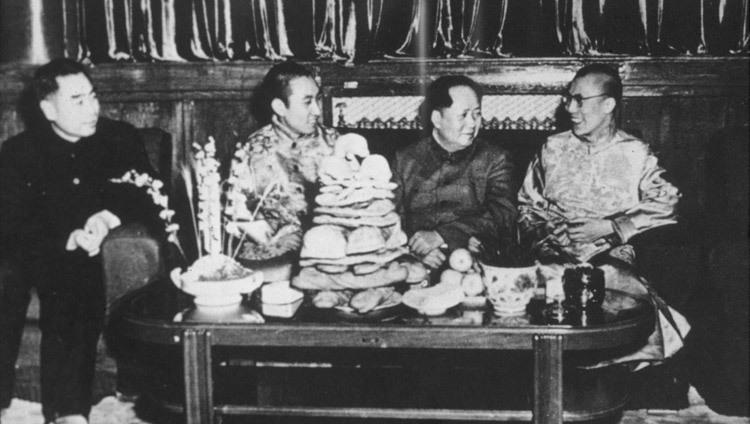 Zhou Enlai, the Panchen Lama, Mao Zedong and His Holiness the Dalai Lama in Beijing, China, in 1956. (Photo: Tibet Images)
In the early years of exile, the Central Tibetan Administration, headed by His Holiness, raised the question of Tibet at the UN. The UN General Assembly adopted three resolutions on Tibet, in 1959, 1961 and 1965.
The process of democratization
In 1963 His Holiness presented a draft democratic constitution for Tibet, and then carried out a series of reforms to democratize the Central Tibetan Administration. The new constitution was called the “Charter of Tibetans in Exile.” The Charter enshrines the freedoms of speech, religion, assembly, movement and choice of residence. It also regulates in detail the work of the Central Tibetan Administration in exile.
In 1992 the Central Tibetan Administration published a plan for adopting a constitution for a future free Tibet. According to it, in a free Tibet it would first be necessary to establish an interim government, whose primary task would be to elect a constitutional assembly to work on drafting and adopting a new democratic constitution for the country. His Holiness expressed the hope that a future Tibet would unite the three historical provinces — Ü-Tsang, Amdo and Kham — and become a democratic federal state.
In May 1990, thanks to His Holiness’s reforms, the Tibetan administration in exile became fully democratic. The Tibetan cabinet of ministers (Kashag), whose members had been appointed by His Holiness, was dissolved, as was the tenth Assembly of Tibetan People’s Deputies (the Tibetan parliament in exile). In the same year, Tibetans living in exile in India and in more than 33 countries around the world elected by direct vote 46 deputies of the expanded eleventh Assembly. The Assembly in turn appointed new members of the cabinet.
In September 2001 the next step towards democratization was taken: Tibetans directly elected the Kalon Tripa, the chairman of the cabinet of ministers. The Kalon Tripa appointed his own cabinet, which was then approved by the Tibetan parliament. For the first time in Tibet’s long history, the people themselves elected their political leaders. After the direct election of the Kalon Tripa, the custom by which the Dalai Lamas, through the Gaden Phodrang, exercised both secular and spiritual authority in Tibet came to an end. In 2011, having fully handed state powers to the elected leadership, His Holiness withdrew from political affairs.
Peace initiatives
On 21 September 1987, addressing members of the US Congress in Washington, His Holiness proposed a “Five-Point Peace Plan,” intended to be the first step towards a peaceful resolution of the steadily worsening situation in Tibet. The five points were as follows:
- The transformation of the whole of Tibet into a zone of peace.
- China’s abandonment of the population-transfer policy that threatens the very existence of the Tibetans as a nation.
- Respect for the fundamental human rights and democratic freedoms of the Tibetan people.
- The restoration and protection of the natural environment and China’s abandonment of the use of Tibet for the production of nuclear weapons and as a dumping ground for nuclear waste.
- The holding of open negotiations on the future status of Tibet and on relations between the Tibetan and Chinese peoples.
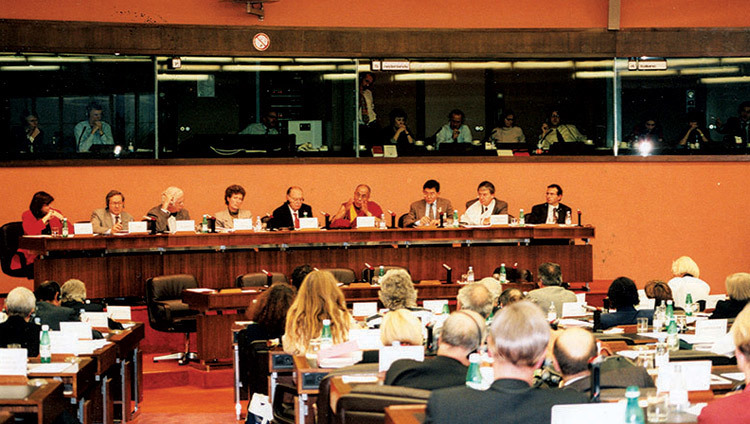 His Holiness the Dalai Lama presenting the “Five-Point Peace Plan” at the European Parliament in Strasbourg on 15 June 1988.
On 15 June 1988, in an address to the members of the European Parliament in Strasbourg, His Holiness put forward a carefully elaborated proposal expanding on the fifth point of the “Peace Plan.” He proposed beginning negotiations between the Tibetan and Chinese sides with the aim of establishing democratic organs of self-government in the three Tibetan provinces. The establishment of such local organs of authority accords with the principles on which the People’s Republic of China is built, while the Chinese government would continue to control Tibet’s international and military policy.
Worldwide recognition
His Holiness the Dalai Lama is a messenger of peace. In 1989 he was awarded the Nobel Peace Prize for his non-violent struggle for the liberation of Tibet. He is a steadfast advocate of the policy of non-violence even in the face of extreme cruelty. He also became the first person to be awarded the Nobel Peace Prize for efforts to protect the environment.
His Holiness has visited more than 67 countries on six continents. He has received more than 150 awards, honorary doctorates, prizes and other distinctions in recognition of his work to promote peace, non-violence, interreligious understanding, global responsibility and compassion. He is also the author and co-author of more than one hundred and ten books.
His Holiness holds discussions with heads of the most diverse faiths and takes part in numerous conferences aimed at promoting interreligious harmony and understanding.
In the mid-1980s His Holiness began a dialogue with modern scientists, mainly in the fields of psychology, neurobiology, quantum physics and cosmology. This dialogue gave rise to a momentous collaboration between Buddhist monks and world-renowned scientists whose goal is to help people attain peace of mind. In addition, the teaching of the natural sciences was introduced into the curricula of the Tibetan monastic universities established in exile.
Relinquishing political authority
On 14 March 2011, His Holiness sent a letter to the Assembly of Tibetan People’s Deputies (the Tibetan parliament in exile) asking it to relieve him of all state powers, since under the “Charter of Tibetans in Exile” he still formally remained head of state. His Holiness announced that he was ending the tradition by which the Dalai Lamas were vested with spiritual and secular authority in Tibet. He explained that he wished to devote himself solely to spiritual pursuits, as the first four Dalai Lamas had done. His Holiness affirmed that the democratically elected leadership was now fully responsible for Tibet’s state affairs. From that moment the Gaden Phodrang would perform only the functions of the official office and the administration of the affairs of the Dalai Lamas.
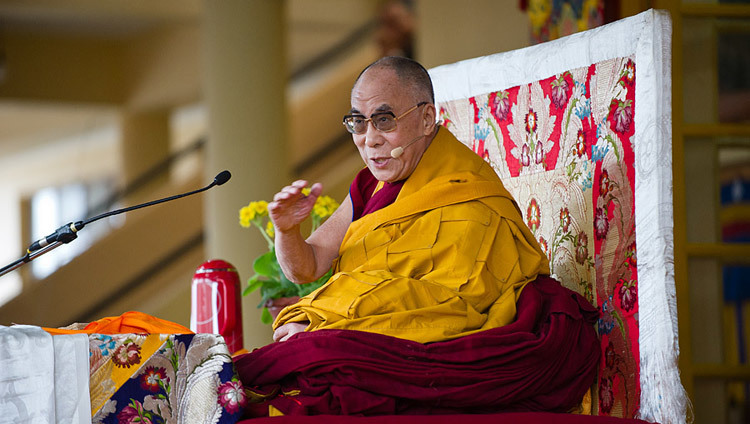 His Holiness the Dalai Lama giving his first official comments on relinquishing political authority during teachings at the main Tibetan temple in Dharamsala. Himachal Pradesh, India. 19 March 2011. (Photo: Tenzin Choejor, OHHDL)
On 29 May 2011, His Holiness signed the document formally transferring secular authority to the democratically elected leader. By this act he officially brought to an end the 368-year-old tradition under which the Dalai Lamas had been the spiritual and secular leaders of Tibet.
The future
As far back as 1969, His Holiness stated clearly that whether or not there would be a new reincarnation of the Dalai Lama was for the Tibetans, the Mongolian peoples and the inhabitants of the Himalayan region to decide. However, in the absence of clear guidelines, there was a danger that could not be ruled out: that if it were decided to continue the line of the Dalai Lamas, certain interested parties might use this for their own political advantage. Therefore, on 24 September 2011, clear guidance was published on the search for and recognition of the reincarnation of the next Dalai Lama, leaving no room for doubt or fabrication.
His Holiness announced that at about the age of 90 he would consult with the senior lamas of the Tibetan Buddhist traditions, the Tibetan people and other concerned followers of Tibetan Buddhism, in order to reassess whether or not the institution of the Dalai Lamas should continue. The guidance also sets out various ways of recognizing his successor. If it is decided that a Fifteenth Dalai Lama needs to be recognized, responsibility for the search should rest mainly with the officers of the Dalai Lama’s Gaden Phodrang Trust. They should consult with the heads of the various Buddhist traditions of Tibet and with reliable oath-bound Dharma protectors inseparably linked with the lineage of the Dalai Lamas. They should heed the advice and directions of the aforementioned and conduct the search and the recognition of the new reincarnation in accordance with their instructions. His Holiness said that he would leave clear written instructions on this matter. He also warned that, apart from a reincarnation recognized through such legitimate methods, no other candidate chosen for political reasons by anyone, including in the People’s Republic of China, may be recognized or accepted.